

Future-Prepared in the Labyrinth of Uncertainties?
A world of uncertain factors, 5 future-proof leadership strategies according to Forbs, and the performance edge of future-prepared companies


The labyrinth of uncertainty
🌍 The world is facing unprecedented levels of uncertainty. The World Uncertainty Index, which tracks uncertainty across 143 countries, reached a record high of 423.84 in the first quarter of 2020, nearly 70% higher than the previous peak during the 2011-2012 euro debt crisis. It remains elevated since–averaged around 200, and hit 246.6 in Q2 2024, indicating persistent global uncertainty.
Forbes Human Resources Council recently released an article on "5 Future-Proof Leadership Strategies for Thriving Amid Uncertainty." While the intent is commendable, I prefer the terms "future-prepared" or "future-forward" over "future-proof." After all, truly future-proofing is technically impossible in our ever-changing world.
📊 Here are key takeaways from the article, contextualized for today's challenges:
Monitoring the landscape: In an era of rapid technological advancements and geopolitical shifts, leaders must constantly scan for emerging trends and disruptions.
Identifying business risks and implications: With global supply chain vulnerabilities and cybersecurity threats on the rise, risk assessment has become more critical than ever.
Leveraging scenario planning: As traditional forecasting becomes less reliable, scenario planning helps organizations prepare for multiple possible futures.
Building flexible and cross-functional teams: In a world where skills quickly become obsolete, adaptable teams with diverse expertise are essential.
Developing agile decision-making processes: With the pace of change accelerating, leaders need to make informed decisions quickly and be ready to pivot when necessary.
The art of embracing uncertainties, rather than avoiding them, is critical for today's businesses. Future-forward leaders understand that the future is plural, with multiple potential outcomes. This perspective not only helps in navigating uncertainties but also opens up possibilities for shaping the future through intentional strategic moves.
Strategic Foresight in Action
There are many impactful examples of Strategic Foresight in action. Let's explore five notable cases, among many more:
DARPA's (Defense Advanced Research Projects Agency) "Futures" program: DARPA's forward-thinking approach has led to groundbreaking innovations like the internet, GPS, and voice recognition technology. Their strategic foresight efforts focus on identifying and investing in emerging technologies that could revolutionize national security and beyond.
Shell's Scenario Planning: Shell has been using scenario planning since the 1970s to navigate uncertainties in the energy sector. Their foresight efforts helped them anticipate and prepare for significant events such as the 1973 oil crisis and the fall of the Soviet Union. This approach has enabled Shell to maintain a competitive edge in a volatile industry.
Stora Enso's Strategic Pivot: The Finnish paper manufacturer recognized the declining market for traditional paper products and used strategic foresight to shift its focus towards innovative packaging and biomaterials. By identifying market trends and potential disruptors early on, Stora Enso successfully adapted its business model to remain competitive in a changing industry.
Tyson Foods' Protein Company Transformation: Tyson Foods, traditionally a meat company, used strategic foresight to reposition itself as a protein company. By investing in plant-based alternatives and cellular agriculture, Tyson adapted to changing consumer preferences and emerging food technologies. This strategic shift demonstrates how foresight can guide even large, established companies through significant transformations.
Singapore's Whole-of-Government Integrated Risk Management (WOG-IRM) framework: This nationally coordinated foresight program has helped Singapore anticipate and prepare for various challenges, from economic disruptions to public health crises. The framework enables the government to identify emerging issues, assess their potential impact, and develop coordinated responses across different agencies.
Key aspects of this framework include:
Organizational Structure: The Centre for Strategic Futures (CSF), situated within the Prime Minister's Office, leads the implementation of the WOG-IRM framework. This central placement provides the CSF with access to high-level decision-makers and legitimacy across the administration
Foresight Methodology: The CSF employs a unique set of tools called SP+ (Scenario Planning Plus), which builds on traditional scenario planning and incorporates elements from complexity theory. This approach consists of six key phases: defining focus, environmental scanning, sense-making, developing possible futures, designing strategies, and monitoring
Capacity Building: The CSF has developed a Strategic Risk Management course in collaboration with the Civil Service College to create a common understanding of strategic risk management among public officers
Impact: The WOG-IRM framework has enabled Singapore to anticipate and prepare for various challenges, develop coordinated responses across different agencies, and continuously improve risk management practices in the public sector
The Performance Edge of Future-Prepared Companies
Research highlighted by the World Economic Forum indicates that corporate foresight can:
Unlock more flexible decision-making
Promote entrepreneurial behaviors
Increase sense of agency among employees
Drive overall firm performance
A study by MIT CISR provides compelling evidence of the benefits of being future-prepared. According to their research, companies with a future-ready workforce outperform their competitors significantly. These organizations deliver 19 percentage points higher revenue growth and 15 percentage points higher net margin compared to their industry average.
A 2020 study by René Rohrbeck and Menes Etingue Kum found that companies with mature foresight practices have a 33% higher profitability and a 200% higher market capitalization growth than the average. Companies categorized as "neurotic" or "in danger" due to misaligned foresight practices underperformed significantly, with profitability 37-44% lower than vigilant companies
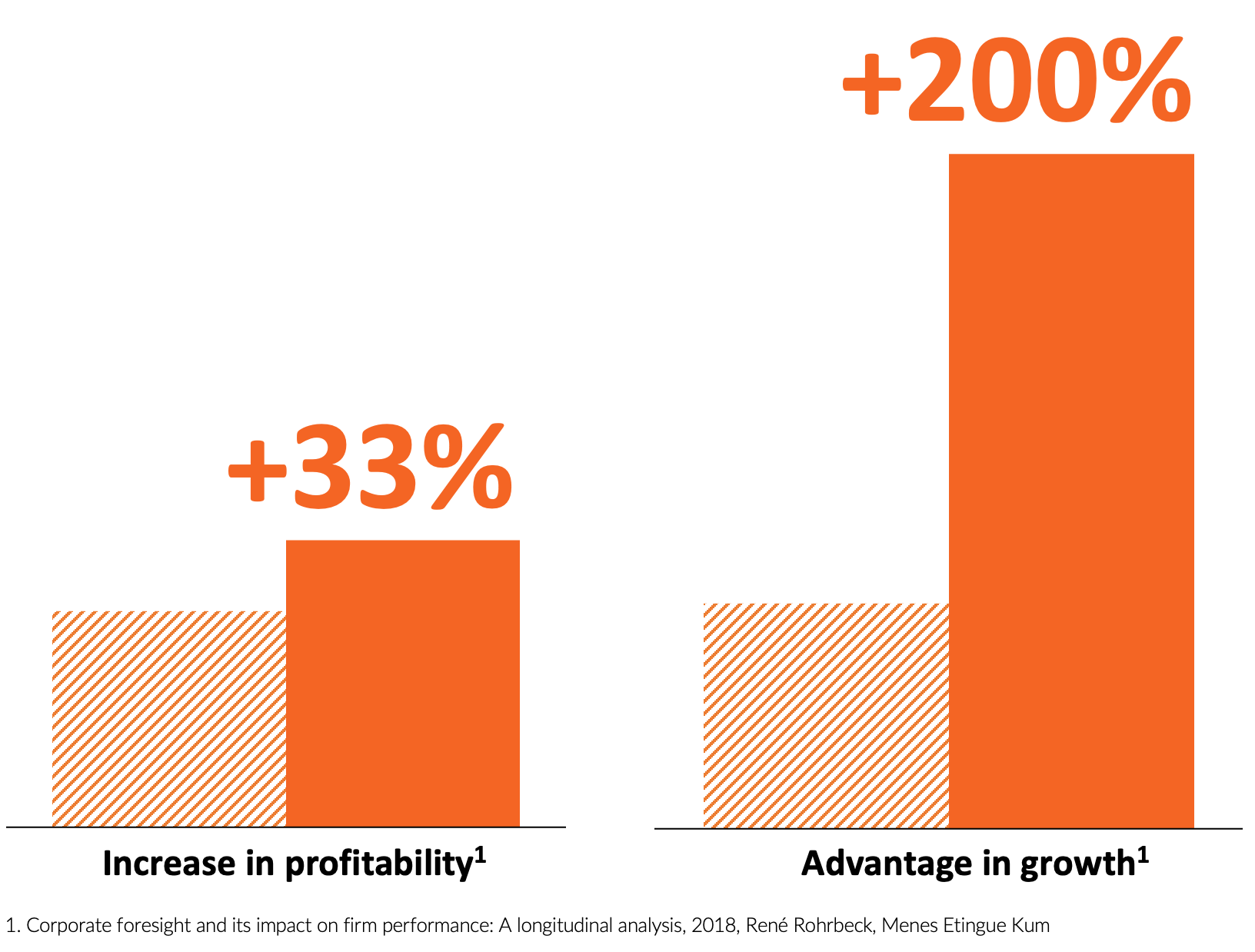
These findings underscore the importance of strategic foresight and future-preparedness in driving organizational performance and competitive advantage.
Food for Thought
🤔 As we navigate this labyrinth of uncertainties, consider:
How can we balance short-term goals with long-term vision in an unpredictable environment?
What role could creativity play in future-forward leadership given the ambiguity and uncertainties?
How can we cultivate a culture that thrives on change rather than resists it?
As co-founder and leader of McKinsey's Design x Foresight practice, I served many clients with the Futures approach in the past 5 years. I'm continuing the work with more leaders with TBD Futures now, helping them navigate uncertainty and capitalize on emerging opportunities. You can find detailed case studies of some of these engagements at www.tbdfutures.com.
Image created with the help of MidJourney
Sources:
https://executiveacademy.at/en/news/detail/how-strategic-foresight-succeeds-prepared-for-the-future/
https://learn.marsdd.com/article/strategic-foresight-a-case-study/
https://cisr.mit.edu/publication/2020_1201_FutureReadyWorkforce_DeryWoernerBeath
https://www.weforum.org/stories/2024/01/strategic-foresight-help-companies-survive-thrive/
PwC's 26th Annual Global CEO Survey
World Economic Forum Global Risks Report 2024
Harvard Business Review: Living in the Futures
Deloitte: The diversity and inclusion revolution
CNBC: Why Jeff Bezos' two-pizza rule is one of the secrets to Amazon's success
World Uncertainty Index
Centre for Strategic Futures: Foresight
DARPA: Our Research