

From Firefighting to Future-Building: The CEO’s New Mandate
The new breed of Futurist CEO. The power of scenario planing. The corporate Foresight flywheel. And questions worth asking.


Despite widespread acknowledgment of the need for long-term thinking, 73% of CEOs admit they’re too consumed by short-term pressures to focus beyond the next quarter. This reactive mindset leaves companies vulnerable to disruption and blindsided by emerging threats.
This is not entirely the fault of these leaders.
The market is uncertain. 63% of leaders see uncertain economic growth as a top threat, ranking it highest among all threats. Only 40% feel prepared to confront these challenges, marking the lowest readiness level since 2021.
CEO tenure has been steadily decreasing over the past decade. The median tenure dropped from 6 years to 4.8 years between 2012 and 2022. More than half (56%) of C-suite leaders are likely or extremely likely to leave their current role in the next two years. CEO turnover reached a new peak with record departures reported in 2024, with the S&P 500 seeing a 21% increase in CEO departures compared to 2023.
Everyone is under severe pressure to deliver within this quarter. Boeing’s leadership under Dennis Muilenburg has been widely criticized for prioritizing shareholder returns and cost-cutting over engineering depth and safety, as documented in multiple investigations and analyses.
I’ve spoken with countless leaders about their strategy and outlook, the desire of long-term thinking is universal, while the proven ROI and the how-to are always questioned. Good thing is that I do have some answers.
The Foresight Advantage: Data-Backed Outperformance
The evidence for proactive, foresight-driven leadership is compelling:
Companies with robust foresight practices are 33% more profitable and achieve 200% higher growth compared to their less future-focused counterparts.
Future-forward firms-those that proactively anticipate long-term shifts and invest in emerging opportunities-outperform their peers dramatically during times of crisis. According to BCG’s analysis of the COVID-19 pandemic, companies that prepared for disruption and acted on visible trends “recovered two to three times faster than their industry, on average.” These new winners didn’t just mitigate risk; they treated the crisis as a growth opportunity, leveraging anticipation, adaptation, and industry-shaping moves to achieve superior revenue growth and long-term advantage.
These statistics underscore a fundamental shift: foresight is no longer a luxury, but a necessity for survival and competitive advantage.
Microsoft: A Blueprint for Futurist Leadership
Microsoft’s transformation under CEO Satya Nadella exemplifies the power of embedding foresight into leadership and culture. When Nadella took the helm in 2014, Microsoft was seen as a legacy tech giant at risk of stagnation. Nadella’s vision was clear: shift from a traditional software company to a future-focused technology leader, betting big on cloud computing, artificial intelligence, and quantum computing.
Key Moves:
Massive, Early AI Investments: Microsoft began investing heavily in AI as early as 2016, acquiring SwiftKey and later committing $13 billion to OpenAI. By 2024, Microsoft had invested over $40 billion in AI across global markets, with a recent $80 billion commitment underscoring its long-term focus31.
Azure and Cloud Dominance: Nadella’s “mobile-first, cloud-first” strategy propelled Azure to become a dominant force, now used by 56% of organizations worldwide.
Cultural Transformation: Nadella fostered a culture of empathy, collaboration, and growth mindset, encouraging continuous learning and experimentation. This shift revitalized Microsoft’s innovation engine and made scenario planning a daily discipline.
Strategic Acquisitions: Under Nadella, Microsoft acquired LinkedIn, GitHub, and other key platforms to expand its ecosystem and future-proof its business.
Sustained Financial Performance: Microsoft’s market cap soared past $3 trillion, and the company became the world’s most valuable, driven by record revenues from AI and cloud services.
Nadella famously spends “a third of his time” on decade-long bets like quantum computing and AI ethics-a radical contrast to the 73% of CEOs who are too consumed by short-term fires to think beyond next quarter. His leadership illustrates how scenario planning, continuous investment in emerging technology, and a culture of learning can turn a legacy company into a future-ready powerhouse.
Scenario Planning: A Daily Discipline, Not a Crisis Drill
This isn’t just Microsoft’s story. Across industries, a new breed of "Futurist CEOs" are rewriting the rules of leadership. They understand what the late Harvard professor Clayton Christensen proved: companies don’t fail because they make wrong decisions—they fail because they make decisions too late.
In 1971, a small team at Shell began gaming out an unthinkable scenario: Arab nations cutting off oil supplies to the West. When the OPEC embargo hit two years later, Shell alone had contingency plans—diverting tankers, securing alternative sources, and ultimately leapfrogging competitors to become the world’s second-largest oil company. Pierre Wack, the architect of Shell’s foresight practice, later wrote in Harvard Business Review that the real breakthrough wasn’t predicting the crisis, but creating an organization agile enough to act when it arrived.
Contrast this with Blockbuster’s fateful 2008 leadership meeting. As Netflix’s streaming service gained traction, CEO Jim Keyes dismissed it with a now-infamous quip: "People will always want the in-store experience." That myopia cost shareholders $5 billion when Blockbuster filed for bankruptcy 24 months later—a cautionary tale about the price of ignoring weak signals.
The lesson? Scenario planning isn’t about being right—it’s about being ready. When Brian Chesky mapped three divergent futures for Airbnb during COVID’s darkest days (hyper-local travel, revenge tourism, and digital nomadism), it seemed like an academic exercise. But by launching tailored products for each scenario—from online experiences to long-term rentals—Airbnb didn’t just survive the pandemic; its valuation tripled while Hilton’s merely doubled.
Anti-Fragile Leadership: Pivots as Policy
Futurist CEOs don’t just survive disruption-they thrive on it.
The Netflix Playbook: Serial Self-Disruption
When Netflix mailed its final DVD in 2023 (a copy of The Irishman to a customer in Texas), it marked the end of a 25-year journey of deliberate self-cannibalization. Reed Hastings didn’t just adapt to change—he engineered obsolescence as a strategy. Each pivot seemed reckless… until competitors realized they were playing checkers while Netflix played 4D chess.
2007 Pivot: With DVD revenues peaking at $1.2B, Netflix launched streaming despite broadband limitations. "We called it 'betting the company' twice—first on streaming, then on originals," Hastings told Harvard Business Review (2020).
2013 Gambit: Spending $100M on House of Cards when licensing content was cheaper. Result: By 2023, Netflix Originals drove 60% of viewing hours (Statista, 2024).
Data Point: Netflix’s market cap grew from 2B(2007)to2B(2007)to290B (2024) through controlled disruption (Bloomberg).
Compare this to Boeing’s tragic miscalculation. In 2017, as Airbus invested heavily in composite materials for its A350, Boeing diverted R&D funds to stock buybacks—a decision that contributed to the 737 MAX crisis and erased $140 billion in market value. The difference? Futurist CEOs don’t just weather storms—they build ships designed to sail through them.
Jeff Bezos’ 1997 letter to Amazon shareholders contained a radical idea: "We will make decisions based on seven-year time horizons." While competitors optimized for quarterly earnings, Amazon plowed profits into cloud computing—a business that seemed absurd for an online bookstore until AWS generated $90 billion in annual revenue.
This kind of long-term playbook explains why Microsoft began quietly acquiring AI startups like SwiftKey in 2016, years before ChatGPT made AI mainstream. It’s also why Kodak—despite inventing the digital camera in 1975—still ended up bankrupt. Former Kodak CTO Willy Shih recalls the fatal hesitation: "We knew digital would eclipse film, but the margins were too good to walk away." That delay allowed Instagram to birth a $100 billion industry on Kodak’s forgotten technology.
The Futurist CEO’s mantra? "Place bets that only make sense in the future you’re creating."
Foresight as Mindset and System: The Dual Imperative
To become an inspiring, future-minded leader is not enough, though. Foresight must be both a CEO mindset and an organizational discipline. Satya Nadella’s Microsoft shows that when leaders dedicate significant time to long-term bets, foster a culture of learning, and systematically invest in future technologies, the results are transformative. However, without robust internal foresight systems-horizon scanning, scenario planning, and continuous monitoring-even the most visionary CEOs risk “lone genius” syndrome.
To implement Foresight as a corporate function, there are multiple paths to success: having dedicated personnel in house, investing in broad training of Foresight in key functions such as Strategy, Finance, Product, Design, and/or involving professional Futurists to help lead and jumpstart Foresight initiatives.
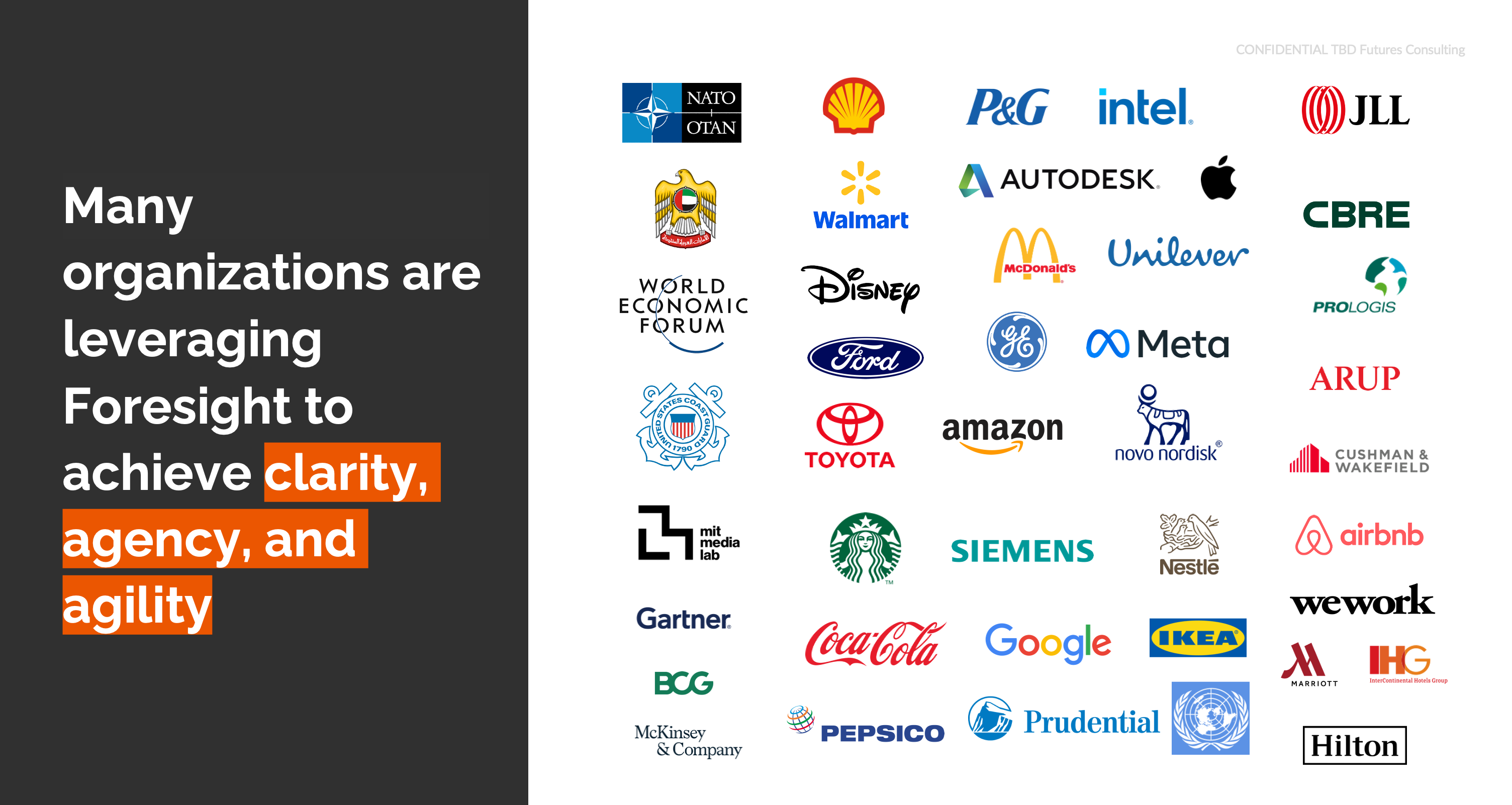
For a recent speaking engagement, I did a quick scan and listed some of the well-known organizations that have been using Strategic Foresight to achieve significant impact, either with an internal team or external consulting support.
There are clear reasons why they can disrupt and lead to their advantages over global competitors, even amidst overwhelming uncertainties in today’s world.
The Foresight Flywheel: How to Build Tomorrow’s Company Today
Nadella’s Microsoft and many of these future-minded leaders offer the blueprint for institutionalizing foresight:
Pre-Mortem Culture: Amazon’s "Day 1" philosophy mandates teams to "write the press release for your project’s failure" before launch (Bezos’ 2016 shareholder letter).
Option Value: Microsoft’s parallel bets on AI (OpenAI), quantum (Station Q), and gaming (Activision) ensure multiple paths to future relevance (Microsoft Annual Report, 2023).
Stress-Test Metrics: Apple tracks "disruption readiness" via R&D spending as % of revenue (6.8% in 2023 vs. industry avg. 3.2%) (Bloomberg Intelligence).
Dedicate Time Relentlessly: Block 20% of leadership calendars for "horizon thinking"—no exceptions.
Reward Failure: Microsoft’s AI team celebrates "noble failures"—bold bets that didn’t pan out but generated learning.
Democratize Signals: Shell’s "Global Business Environment" team publishes weekly trend briefings for all employees.
As you finish this article, I invite you to ask yourself:
When was the last time you canceled a quarterly review to discuss 2030 scenarios?
Do your team meetings dissect weak signals (like Microsoft tracking AI ethics debates in 2016) or just strong results?
Audit your last 5 strategic decisions—what % allocated to protecting the present vs. inventing the future?
How many, if any of your executive team members and their direct reports are thinking beyond a linear and singular timeline with the discipline of Strategic Foresight? Are they supported with adequate resources to do it well?
The Futurist CEO’s advantage isn’t prescience—it’s the discipline to build before the need becomes obvious. As Shell’s Wack once warned: "The future never actually arrives. What arrives is a present you either prepared for… or didn’t."
→ Action: Forward this to your leadership team with the subject line: "Our 2030 Premortem Starts Monday."
I’m a Futurist helping leaders become more future-aware, future-prepared, and future-active. Let me know how I can help you.
Sources
Market Uncertainty & Short-Term Pressure
AXA IM: Market uncertainty ramps up as geopolitical tensions rise (2025)
LinkedIn: Evaluating CEOs Beyond Quarterly Financial Performance (2024)
CEO Tenure & Turnover
Foresight ROI (Profitability & Growth)
Resilience & Crisis Recovery
Microsoft Case Study
CRN: AWS, Microsoft, Google Fight For $90B Q4 2024 Cloud Market Share
LinkedIn: My take on Microsoft's acquisition of Activision Blizzard
Forbes: To Navigate Today's Chaos, Lengthen Your Time Horizon (2025)
Scenario Planning & Organizational Agility
Polytechnique Insights: Case study: how Shell anticipated the 1973 oil crisis (2023)
LinkedIn: What Killed Blockbuster Wasn't Netflix-It Was Leadership's Failure (2025)
Netflix, Amazon, and Long-Term Thinking
Boeing Critique